Powerful systems are defined by how easily people can use them.
The Blind Computer has been designed to handle private data, coordinate across nodes while running computation without exposure.
But as these capabilities grow, so does the importance of how those capabilities are experienced.
In Phase 1, we brought together the core layers of the Blind Computer: nilDB, nilCC, nilAI into a single, privacy-first stack.
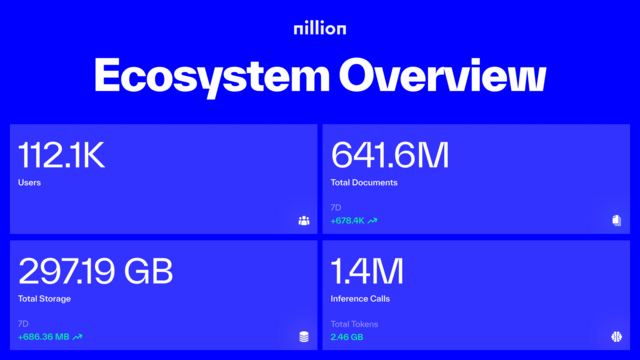
Since launch, the Blind Computer has grown to 112K+ users, 641M+ documents, and 1.4M inferences, powering real applications across the network.
Phase 2 builds on that by making the system easier to use and navigate.
It changes how developers move across nilDB, nilCC, and nilAI, and introduces a new way to access the network through a credits-based system instead of subscriptions.
Together, these updates reduce friction and make the Blind Computer a single platform.
A Unified Developer Portal Is Live
Phase 2 introduces a unified developer portal across nilDB, nilCC, and nilAI.
Instead of working across separate surfaces, developers now have a single place to interact with the Blind Computer.
The portal is where developers can manage usage, buy credits, track balances, and access all three services. It also brings API key management into one place, removing the need to move between different environments.
Developers working with nilDB can upload and manage schemas for their data. Those using nilCC can deploy workloads and manage them directly.
These actions now live within the same interface instead of being dispersed across different surfaces.
The goal is simple: spend less time figuring out how the system works, and more time building on it – make the user experience great.
From Subscriptions to Credit Based System
Phase 2 also changes how developers can access the Blind Computer.
nilDB, nilCC and nilAI now operate on a credit based system instead of subscription.
Subscription models can work when usage is fixed and predictable, but that doesn’t reflect how developers actually build. Usage shifts depending on what’s being built and how it evolves.
A credits-based model fits that reality better.
For nilDB and nilCC, credits are purchased using the NIL token. Through the developer portal, developers can burn NIL and allocate credits to specific nodes. This creates a direct link between the token and the resources being used, while giving developers control over how those resources are distributed.
nilAI works slightly differently at the surface level.
Because nilAI runs on nilCC, it still consumes compute paid in NIL. But to make it easier to get started, nilAI supports stripe payments, giving developers a familiar entry point without needing to manage NIL tokens upfront.
Under the hood, the alignment remains the same. At the UX layer, the experience is much simpler.
The Road Ahead
From the beginning, the goal has been to make the Blind Computer something developers can actually build on without friction.
Phase 2 moves in that direction.
Building with privacy should be as simple as building without it.
As that happens, something else becomes just as important, being able to see and verify what’s happening across the system.
That’s where Nillion Blacklight comes in.
Blacklight gives developers and users a way to verify activity on the network, adding a layer of visibility on top of everything being built.
As the Blind Computer becomes easier to use, it also becomes easier to trust.
Explore the unified developer portal and get started today.