Telecom towers can host AI compute at the edge.
With additional hardware, each site can operate as a mini AI data centre, and together towers can form a virtual data centre distributed across locations.
This post focuses on the first practical blocker to making that real: financing.
Pairpoint by Vodafone has partnered with Nillion and Chainlink on a usage-based financing model for tower-deployed AI compute. Usage data is captured from tower hardware, verified privately, and published onchain for settlement. Tower companies can start with low repayments while demand is still emerging, with payments scaling as usage grows.
This collaboration aims to bring privacy-preserving, verifiable compute to the network edge, enabling low-latency AI services while meeting stringent data sovereignty and privacy requirements.
In this post, we cover:
- The rapid growth of AI
- Telecom towers as infrastructure for edge AI
- Phase 1: Proof of Asset + Proof of Use
- How usage measurement moves from towers to onchain settlement
- What comes next
The Rapid Growth of AI
Over the past three years, AI adoption has accelerated across consumer and enterprise markets.
That shift is driving major investment in next-generation data centres. Yet the industry faces constraints:
- Extremely high upfront capital costs
- Significant energy consumption and environmental impact
- Growing public and political resistance to new builds
In fact, $64 billion worth of planned data centre projects have already been blocked due to community opposition over rising electricity costs and environmental concerns (Data Center Watch).
There is also a mismatch in how capacity is built today. Centralised hyperscale data centres are optimised primarily for model training, not real-time inference and their distance from end users increases latency and makes real-time performance harder to maintain.
Telecom Towers for Edge AI
Telecom towers already offer many of the building blocks needed to host AI compute.
- Close to users
- Reliable power and cooling
- High-capacity network connectivity
- Physical space for additional hardware
By co-locating AI inference hardware with existing telecom equipment, operators can reduce latency and deliver real-time AI performance at the network edge, where it is needed most.
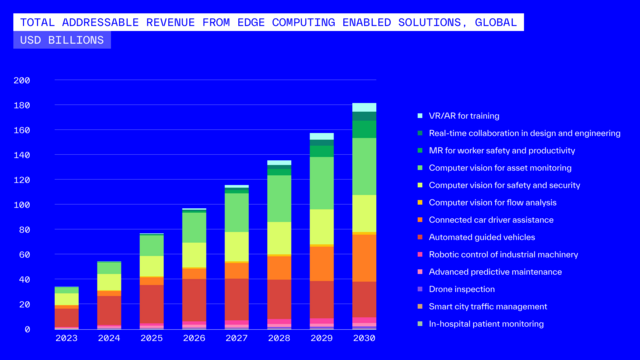
Industry forecasts predict the cell tower AI-edge computing market will exceed $180 billion by 2030.
How the Integration Enables It
Phase 1: Proof of Asset + Proof of Use
Phase 1 demonstrates a Real-World Asset (RWA) framework for deploying and monetising AI edge compute infrastructure on telecom towers.
It establishes Proof of Asset and Proof of Use, so usage-based finance can settle on verified activity rather than reporting.
Working with Pairpoint, Chainlink, and Nillion, the solution combines
- Secure hardware attestation
- Confidential computing
- Decentralised storage
- Blockchain-based settlements.
Together, these create a verifiable, trust-minimised foundation for distributed AI inference at the edge.
Edge AI Infrastructure on Towers
Phase 1 starts at the site level, where AI compute hardware is deployed alongside existing telecom infrastructure.
Each participating site hosts two core systems:
- Telecom equipment: traditional radio and network systems
- AI edge infrastructure: new compute nodes optimised for AI inference, including:
- CPU and GPU capacity
- Local storage for models, datasets, and metrics
- Secure telemetry powered by Pairpoint
This co-location delivers ultra-low-latency AI services directly from the network edge.
Proof of Asset
Each AI-enabled site is represented as a tokenised real-world asset.
Infrastructure ownership and deployment are recorded onchain, allowing investors to purchase RWA tokens that represent fractional ownership of the compute capacity.
The process includes onboarding and registration of tower operator hardware, KYC / KYB verification via trusted banking and verification partners, and issuance of tokens to verified investors.
Proof of Use Measurement
Once live, Pairpoint’s secure telemetry module continuously measures real AI compute utilisation.
It tracks CPU/GPU cycles, storage activity and network throughput tied to inference workloads.
These measurements are turned into cryptographically signed Machine Data Records (MDRs), providing tamper-proof proof of actual usage.
Secure and Verifiable Data Flow
The flow works in four steps:
- Local signing: Pairpoint signs usage data using SIM-based hardware identities
- Confidential validation: Data is processed inside Nillion’s secure enclave, verified by Pairpoint Secure, and secret-shared across Nillion’s decentralised MPC network
- Secure aggregation: Nillion’s enclave creates confidential, aggregated usage metrics
- Onchain publication & settlement: Chainlink oracles retrieve verified data from the
enclave and publish it onchain, triggering smart contract settlements and investor returns
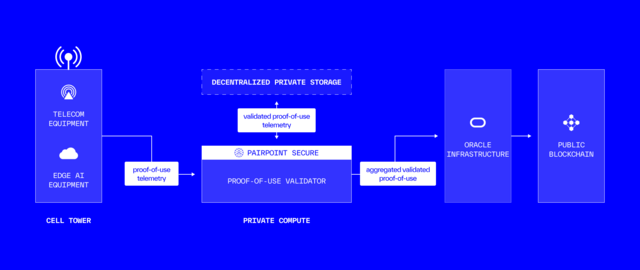
Figure 1: End-to-end flow from signed tower telemetry to privately verified usage metrics and onchain settlement.
How Trust Is Distributed
Trust is not held by any single party. It’s split across independent layers.
- Pairpoint provides SIM-based cryptographic signing at source.
- Nillion enables MPC-based fragmentation and blind computation.
- Chainlink delivers decentralised oracle consensus.
- Banking and verification partners support real-world identity verification.
What’s Next
Some reports estimate that more than $3 trillion could be invested in AI data centres by 2030.
Adding AI compute capability to telecom towers offers a scalable, sustainable way to help meet this demand.
Phase 1 proves that usage-linked financing can unlock capital for early-stage deployments, even when initial demand is low.
The next step is to enable active AI inference directly at the edge, transforming each tower into a fully functional micro AI data centre.
Every watt of compute power is cryptographically attested, privately validated, and transparently recorded onchain.
Pairpoint by Vodafone will collaborate with Nillion and Chainlink to build on finance which created the trustable, secure and private connection between telecoms towers and finance to explore how these towers can work together to provide the compute in a distributed and collective way to maximise scale and output.
This transition could complement centralised AI data centres with the distributed connectivity infrastructure of towers providing verifiable, private AI compute.
Voices from the Collaboration
“By leveraging Pairpoint Secure and Nillion capabilities, with Chainlink runtime we can securely and reliably translate telecom tower activity metrics, and the same for any other connected device or infrastructure at the edge, into trusted usage data for immutable and verifiable storage on-chain, for use by new finance products that want to incorporate usage data into repayments models. With over 20 billion connected IoT devices and billions in connected infrastructure across the globe the potential for this is significant creating the possibility for low repayments in initial phases where usage is low, but higher returns for lenders and investors where demand and usage increase. This could be important for AI which is expected to follow a similar trend curve.”
– David Palmer, Chief Innovation Officer at Pairpoint
“I’m very excited to work with Pairpoint on this major initiative to revolutionize real-world telco infrastructure. Backed by major industry players Vodafone and Sumitomo, Pairpoint is a global infrastructure innovator whose work in edge AI is shaping the future of IoT systems. By leveraging CRE, Pairpoint can move tower usage and pricing data onchain to calculate investor rewards from real-world activity, unlocking the secure orchestration and real-time data integrity required to transform telco infrastructure globally. I look forward to seeing how this major partnership unlocks new capital flows into the onchain economy.”
– Johann Eid, Chief Business Officer, Chainlink Labs
“I am excited about this step to leverage privacy technologies within telco infrastructure. This represents an important pathway for operators to access funding for expansion into new areas such as AI to unlock new revenue streams. The privacy and verifiability aspects of our technology can be foundational in ensuring secure AI inference at the edge across distributed cell tower infrastructure.”
– Lukas Bruell, Chief Commercial Officer, Nillion
“Where large volumes of investment are required, particularly for businesses that lack access to such capital, pooling institutional investors into funds and sharing revenue as profits are realised can create a scalable, collaborative model enabled by innovative financial instruments. For these types of transactions, a trusted mechanism is needed to allow financial institutions to measure and verify asset usage. An example of this model could be the upgrade of telecom assets, serving as AI infrastructure enablers.”
– Tilly Gilbert, Director, Consulting & Edge Practice Lead at STL Partners