


Nillion 2.0 marked a fundamental shift in how the Nillion network operates, moving toward decentralisation, becoming permissionless and placing the Blind Computer in the hands of the community.
In our previous update, we powered our decision to migrate Nillion from a Cosmos L1 to an Ethereum L2 architecture.
That move was driven by a simple goal: to give the Blind Computer a neutral, globally accessible decentralised foundation that could incentivize community participation in operating and verifying the network.
Today, that move is complete.
Nillion is now on Ethereum.
Why Ethereum
Ethereum is the coordination layer of crypto’s open economy. It is where complex systems are settled, composed and governed in the open and where new primitives become shared infrastructure.
Ethereum’s breakthrough was not just decentralisation, but programmability. It allowed developers to encode logic and coordination directly into software.
Nillion builds on that foundation. By allowing systems to coordinate publicly without exposing private computation, the Blind Computer extends what programmable systems can do, without forcing every strategy or execution path to be public by default.
As Nillion’s Blind Computer evolves from a core-operated network into a community-run system, Ethereum provides the coordination layer required for that transition. At the same time, Nillion’s integration into the ecosystem reinforces Ethereum’s commitment to enshrining privacy in its foundational infrastructure.
Migrating to Ethereum strengthens Nillion. It allows the network to scale globally, integrate more easily with existing systems, and operate within the ecosystem where decentralised markets and applications already live.
It also introduces a meaningful staking primitive for the first time. Through verification and node operation, NIL is used not only to secure the network, but to coordinate work and value exchange across the Blind Computer’s infrastructure.
With the Ethereum ecosystem advancing towards encrypted coordination and private execution, Nillion helps it push privacy beyond transactions and into the systems that govern markets, computation and decision-making.
What the Blind Computer Enables on Ethereum
The Blind Computer is Nillion’s privacy-preserving compute and storage platform. It allows computation and data usage to take place without exposing the underlying inputs.
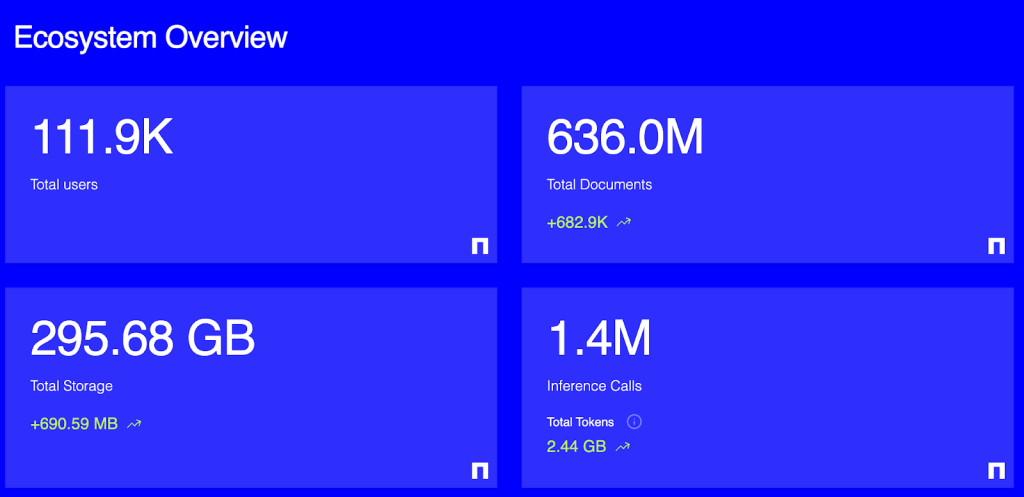
Today, across the ecosystem, the applications collectively serve over 111,000 users, store more than 636 million documents, and have executed 1.4 million inference calls, all powered by the Blind Computer under the hood.
Moving the Blind Computer onto Ethereum changes where this capability can be used. Ethereum is where most decentralised applications are deployed, and where developers actively experiment with new market structures, agents, coordination mechanisms, and execution logic.
With the Blind Computer available in that environment, private computation is no longer confined to individual applications. It can be incorporated directly into how systems are designed, allowing execution and coordination to remain onchain where transparency is required, while sensitive logic or analytics can run privately.
Bringing the Community into the Network
As the breadth of our network expands, control of the Blind Computer shifts outward and moves toward community operation. Community members will be able to run nodes and help ensure the system continues to operate as intended.
This transition is introduced through Nillion Blacklight, the network’s verification layer, launching on February 2, 2026.
Verification on Blacklight is performed by permissionless Blacklight nodes, run by community members who help secure the network and earn rewards for doing so. To operate a Blacklight node, participants will be required to stake 70,000 NIL, aligning long-term incentives between node operators and the integrity of the network.
The first step toward participating in this phase, including running Blacklight nodes, is migrating your $NIL from Cosmos to Nillion’s L2.
Step-by-Step Migration Guide
To take part in the next phase of the network, including node operation, $NIL must be migrated onto Nillion’s L2.
As part of this transition, staking rewards on the Cosmos chain will be phased out, and Cosmos-based $NIL will no longer earn yield. Participation in staking and verification will move to Nillion’s Ethereum L2.
You can begin the migration via: migrate.nillion.com
The migration process happens in two simple steps.
Step 1: Migrate $NIL from Cosmos to Ethereum (ERC-20)
If you currently hold $NIL on Cosmos, migrate it to Ethereum as an ERC-20 token using the official migration flow.
Follow the step-by-step guide below to complete this process 👇
Step 2: Move $NIL from Ethereum to the Nillion L2
Once your $NIL is on Ethereum, move it into the Nillion L2 by heading to this link: https://bridge.nillion.network/
Watch this 👇
For further details, follow the migration documentation here.
What’s Next
With migration underway, the rollout of Blacklight will begin in stages.
We will start by launching compute verification, with an initial cohort of verifier nodes planned for early 2026. Verification for storage will follow after.
More details on Nillion Blacklight and Blacklight Nodes will be shared in the next update.
The World Computer made the internet programmable.
The Blind Computer makes programmability private.
This is the next step, and we want to take it with you.