


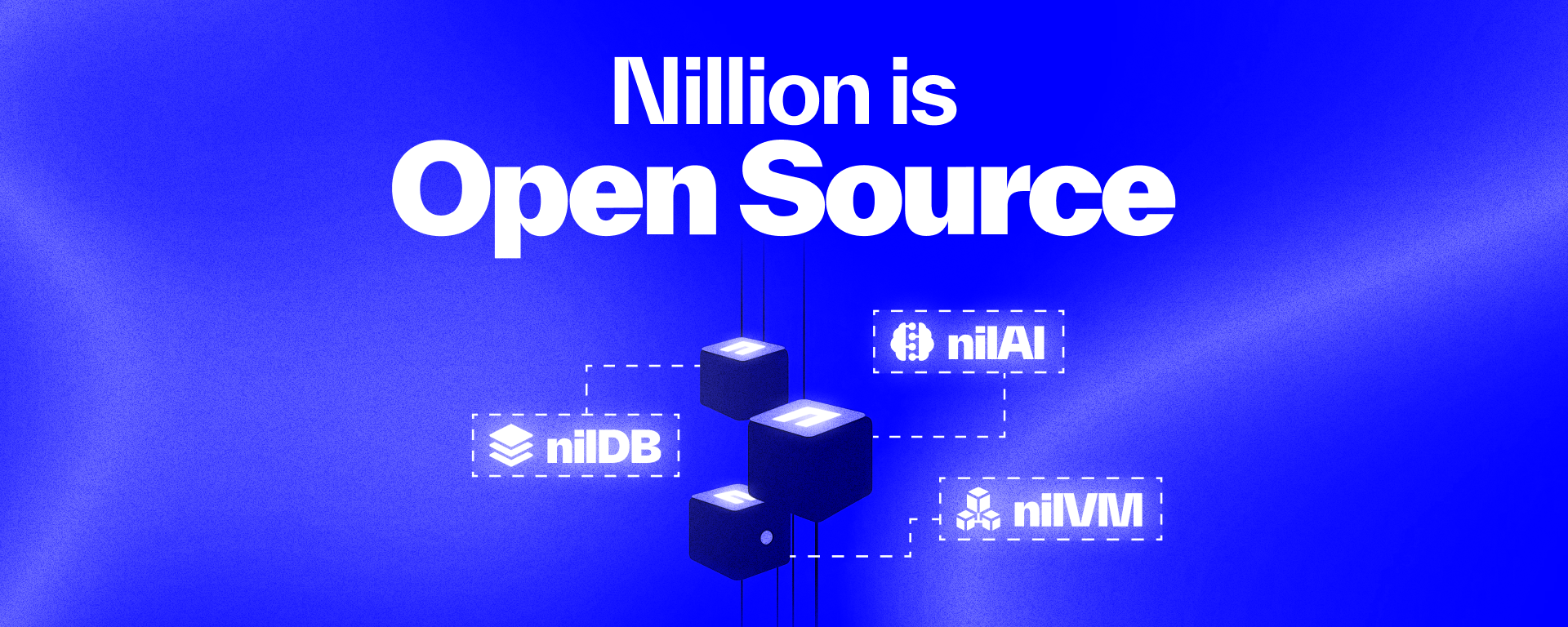
We’ve open-sourced our entire suite of Blind Modules – nilDB, nilAI, and nilVM. These technologies form the foundation of our Petnet, handling all the complex cryptography needed to keep sensitive data private while it’s being used. By open-sourcing these modules, we’re making advanced privacy techniques accessible to everyone, not just cryptography experts.
What are Blind Modules?
Blind Modules are the core technologies that enable our privacy infrastructure. They implement advanced cryptographic techniques like secure multi-party computation (MPC), homomorphic encryption (HE), and trusted execution environments (TEEs) so you don’t have to. Our three Blind Modules – nilVM, nilDB, and nilAI – each solve a different privacy challenge:
- nilDB is our encrypted database solution for private data storage and analytics
- nilAI is our secure AI infrastructure for private model inference
- nilVM is our distributed computation engine for secure multi-party processing
Developers interact with these modules through our user-friendly SDKs, which provide REST APIs that make it easy to build privacy into any application. Now that we’ve open-sourced the Blind Modules underlying these SDKs, the entire privacy stack is available for anyone to use, modify, and improve.
nilDB: Storage and analytics for private user data
nilDB is our secure database solution that splits your data across multiple nodes. When you store information in nilDB, you can choose which sensitive fields are encrypted and divided into shares, with each node holding only one share. This means no single node ever has access to your complete data. If someone breaches a node, they only get meaningless fragments.
The real power of nilDB is that it enables analytics on this distributed, encrypted data. You can run queries across your encrypted information without decrypting it first and without bringing all the data together in one place. This lets you analyze patterns, generate insights, and extract value from your data while maintaining privacy—solving the traditional tradeoff between data utility and data protection.
You can use nilDB through SecretVault and SecretDataAnalytics, which gives you a simple REST API. The workflow is straightforward: register your organization, define your data collections with a JSON schema, then use the blindfold encryption library to encrypt sensitive fields before storage. When you need to run analytics, you can query across the encrypted data without compromising privacy.
nilAI: Private AI that actually works
nilAI addresses the fundamental privacy problem in AI: how do you use powerful AI models without revealing your sensitive data to the model provider? Our solution runs AI models inside Trusted Execution Environments (TEEs) – isolated regions of the processor where even the cloud provider can’t access the data being processed.
When you use nilAI, your prompts, data, and the resulting outputs remain completely private. The model runs in a secure environment with cryptographic verification, so you can prove your data was processed privately. This creates a trusted execution path for AI workloads.
Developers access nilAI through SecretLLM, which is compatible with OpenAI-style APIs. You send prompts to SecretLLM over HTTPS, they run inside the TEE, and you get results back with proof they were processed privately. It works with models like Llama-3.2, Llama-3.1-8B, and DeepSeek, so you have options depending on what you’re building.
nilVM: Compute without exposing data
nilVM is our distributed computation engine that enables secure multi-party computation. It allows code to run across multiple nodes while maintaining data privacy throughout the entire process. nilVM includes a specialized virtual machine that executes programs in a way that keeps inputs, intermediate states, and outputs private.
A key feature of nilVM is its ability to perform cryptographic operations without exposing sensitive keys. This is particularly powerful for applications that need to sign transactions or verify identities without revealing the underlying credentials.
The easiest way to use nilVM is through SecretSigner, which lets you sign messages and transactions without exposing your private keys. Your keys get split across nodes, and you can even grant specific permissions for who can use them. When signing, only message hashes go to the network, not the actual content. For more complex use cases, you can write custom programs using our Nada language and deploy them across the nilVM network.
What can you build?
With these tools, developers are already creating privacy-preserving applications across multiple industries:
- Healthcare: Applications that analyze patient data while keeping it confidential
- Finance: Tools that enable collaborative analysis without pooling sensitive data in one place
- Web3: Dapps and AI agents that can’t see your private keys
- Enterprise: Multi-party workflows where participants contribute without revealing inputs
The momentum is building rapidly. In the last month community developers have built over 50 AI Agents and mini apps using Nillion SDKs.
Why open-sourcing matters
Open-sourcing our Blind Modules represents a significant step for privacy technology. Until now, building privacy-preserving applications required either deep cryptography expertise or settling for inadequate solutions. Privacy tools have been locked away in academic papers, hidden behind expensive licenses, or kept as closely-guarded proprietary systems. By releasing these modules as open source, we’re changing that dynamic.
Now, any developer can build with PETs without becoming a cryptography expert first. The technical barriers that once kept privacy features out of mainstream applications are falling away. The security benefits are equally important. Privacy technology is too important to remain in black boxes. With open source, the entire community can inspect the code, identify vulnerabilities, and contribute improvements. This transparency builds trust and strengthens the technology for everyone.
This is about setting a new standard where privacy isn’t an expensive add-on but a fundamental part of how applications work. As privacy regulations grow stricter and users become more concerned about their data, developers need practical tools to meet these challenges without compromising functionality.
TFTI (Thanks for the invite)
We’re inviting the community to build with our tools, contribute to the code, and help us create a digital world where privacy doesn’t come at the expense of capability. The code is open, the documentation is available, and we’re here to support you as you build the next generation of privacy-preserving applications.