


Ethereum gave us the ‘World Computer’. Nillion gives us the ‘Blind Computer’.
Where Ethereum cryptographically guarantees the integrity of computation, Nillion guarantees the privacy of the data being stored and computed on. Built using a modern stack of privacy-enhancing technologies such as MPC, Secret Sharing, HE, and TEEs, Nillion enables enterprise grade, high performance apps, with end-to-end privacy.
The endgame for Nillion has always been decentralization. Nillion is evolving into a permissionless network where $NIL is natively embedded in the stack as the engine of execution, coordination, and growth. A flywheel economy where rewards flow to those who run the network, not extract from it. And a topology where the community isn’t just participating, they’re forming the backbone of a privacy first crypto ecosystem.
Decentralisation
Until now, Nillion’s core privacy infrastructure has been operated by our internal team and trusted enterprise partners, names like STC Bahrain, Alibaba Cloud, Deutsche Telekom, and Pairpoint by Vodafone. This phase was about resilience, performance, and proving the Blind Computer at scale.
Now, with the $NIL token launched, we begin the next chapter, scaling the network through permissionless decentralization. $NIL becomes the incentive layer, driving the growth of a global community operated privacy operating system, where benefits are directed not to middlemen, but those who provide real infrastructure.
The $NIL economy
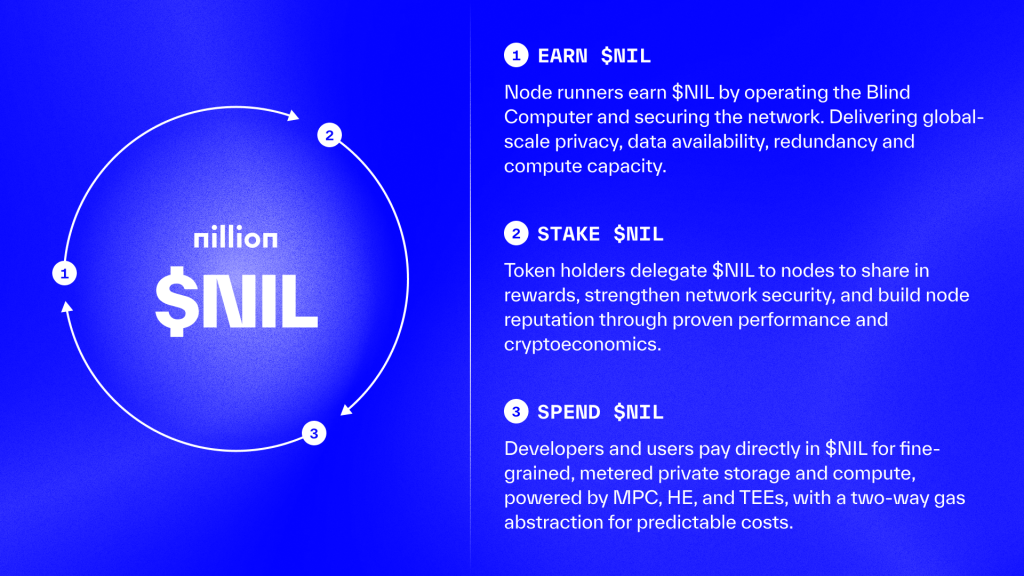
Nillion 2.0 puts $NIL and the community at the core of the network’s architecture. The token will be inseparable from how Nillion operates, it powers computation, coordinates participation, rewards contribution and incentivises decentralised attestation checks. By embedding $NIL directly into the stack, value moves in sync with the network itself, circulating between users, node runners and builders as the system grows.
With the coming upgrades the community will see:
- The redirecting of $NIL rewards from the hands of professional validators to Nillion community nodes.
- The creation of a direct revenue stream for Nillion node runners and holders during idle periods.
- The creation of a deeper economy where token holders now own a part of the network, not just the right to use it.
- Bootstraps a decentralised sea of community Petnet and Attestation node runners and attestation checkers yielding data veracity, availability, redundancy, sharding, robustness, optionality, and critically, global scale.
Tokenomics – building a high growth, sustainable $NIL economy
As we integrate $NIL more deeply into the tech stack, establishing it as the backbone of the ecosystem’s economy across revenue, reputation, and rewards, we’re undertaking a first principles review of tokenomics.
Our objective is a dynamic equilibrium between supply and demand, balancing emissions and burns on one side with utility, staking, and reward mechanisms on the other. This balance fosters scarcity and reinforces positive network effects.
We’re running a structured evaluation of the key economic levers that will shape the $NIL economy. Before publishing the full models, we will be optimising the below components:
- Emission dynamics: we’re designing how new $NIL will enter circulation, and whether an inflationary or deflationary model best supports long-term network security/growth – we are modelling supply and demand curves, optimising for geometric rate early adoption, whilst ensuring we asymptotically approach a steady-state that supports long term functionality.
- Burn mechanisms: we’re assessing the role of token burns as a mechanism to align network usage with ecosystem sustainability, where utility-driven burns help regulate supply in proportion to activity. We’re considering usage burn, slashing burn, and treasury buybacks as methods to manage token scarcity.
- Staking architecture & thresholds: we’re defining what minimum threshold should exist in order to participate in staking, and how these thresholds might evolve over time to maintain security/operator reputation whilst encouraging decentralisation.
- Reward mechanics: we’re evaluating how Nillion operators, delegators, and contributors are rewarded, balancing yield percentage with sustainable token supply, ensuring incentives are aligned with contribution to network quality.
- Economic sustainability: we’re modeling how revenue generated from network utility will sustain incentives, reducing reliance on emissions over time.
- Market stability: we’re introducing a two-way gas abstraction which complements the new token based cost-model. This will keep operational costs predictable for both users/developers and Nillion operators – critical as demand increases.
- Governance: we’re exploring how token holders will be empowered to vote on economic parameters such as staking rewards, emission schedules and fee structures, ensuring the community has a say in the economic evolution of the network.
These economic levers sit atop a native $NIL cost model. All operations, storage, compute, or private inference require $NIL, positioning it at the core of the Blind Computer. Developers spend $NIL for workload execution, node runners set minimum thresholds based on resource availability and demand and checkers cryptographically verify the correctness of the network at all times. This creates a dynamic, market driven equilibrium, while reputation scores and staking provide signal and protection against malicious actors. In this system, $NIL becomes more than a means of payment, it is the economic substrate of the Nillion Blind Computer.
The Unified Vision
Conclusion
Nillion is entering its next chapter, building towards being, decentralized, permissionless, and driven by a native economic engine.`
With $NIL embedded into the stack, the network aligns usage and rewards, infrastructure with contribution, and community participation with protocol growth. Value no longer leaks to passive blockchain validation, it circulates through those who run the Nillion Blind Computer.
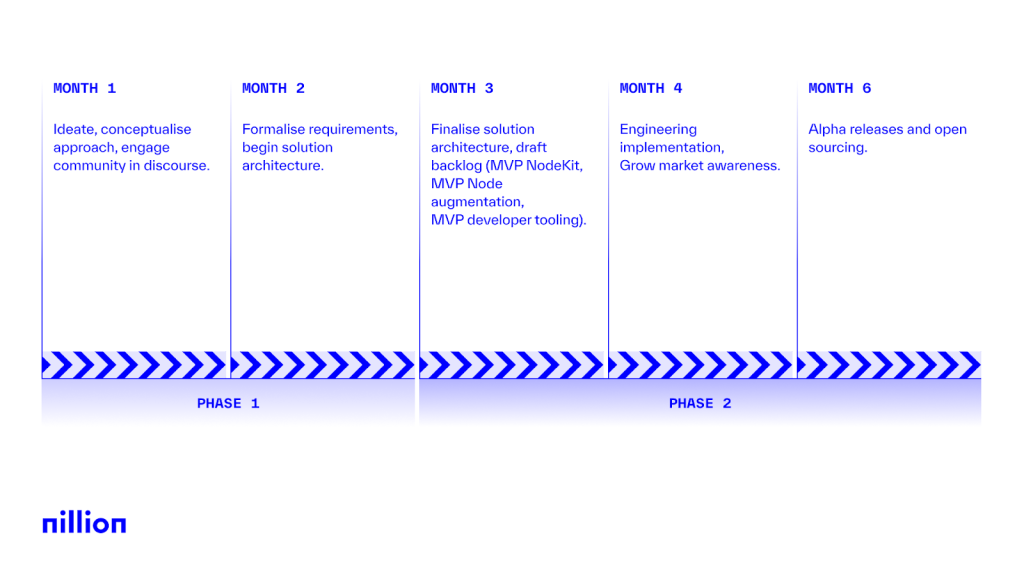
Over the coming months, we’ll roll out a new staking mechanism, node incentives, a $NIL network cost model, and a new node onboarding process. Each upgrade brings Nillion closer to a network where computation, coordination, and compensation are all powered by $NIL.
Risk Disclosures and Disclaimers: The information provided does not constitute financial advice, and the NIL Token’s value is not guaranteed to remain stable or increase over time.
This crypto-asset marketing communication has not been reviewed or approved by any competent authority in any Member State of the European Union. The offeror of the crypto-asset is solely responsible for the content of this crypto-asset marketing communication.